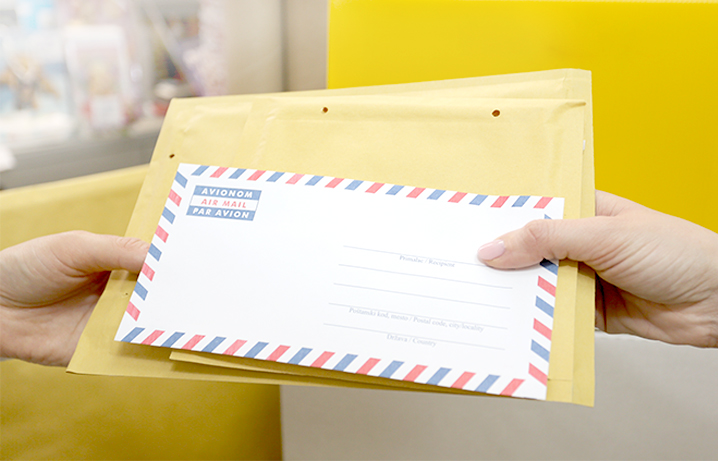
With the Post, your small packet of goods reaches every corner of the world.
Small packet is a letterpost item in international postal traffic that contains goods and other objects. It is also permitted to place any other document that has the nature of current and personal correspondence in a small packet, provided that it is addressed to the recipient of the small packet and is sent by the sender indicated on the small packet. Under the above stated conditions, small packets may contain audio, video and other electronic records, etc. It is permitted to place a list of contents, technical conditions, price of goods and senders’ and recipient’s address in a small packet.
Dimensions of small packets are as follows: the sum of length, width and height – up to 90 cm, with the largest of the three dimensions being a maximum of 60 cm. The smallest dimensions of a small packet are 10.5 x 14.8 cm.
If the small packet is in the shape of a cylinder, the dimensions are as follows: the sum of the length and two diameters may not exceed 104 cm, with the largest of these dimensions being up to 90 cm. The sum of the length and two diameters may not exceed 30.4 cm, with the length of the small packet being at least 21 cm.
Small packet can weigh up to 2 kg.
The wrapping and packaging of small packets must be provided in a way that ensures the integrity of the contents of the postal item during transfer and delivery.
The sender shall submit small packets open so that an employee of the Post, in the presence of the sender, can inspect the contents of the item, in accordance with the regulations governing customs and foreign exchange control of postal items.
Tracked small packet
Tracked small packet is a registered letterpost item in international postal traffic, containing goods, for which status tracking is provided in accordance with the acts of the Universal Postal Union.
Proper addressing
Proper addressing ensures fast and safe delivery.
Postal items destined for abroad are addressed in accordance with the regulations of the destination country. The recipient's address is written in Latin script and Arabic numerals, although it may also be written in the script of the destination country, with the obligation to write the name of the destination country in Latin script on the last address line.
Sender’s address
It is not mandatory to indicate the sender's address on non-registered items, except in the case of submission of items by contract and in case of items exempt from paying postage or part of the postage. On all registered postal items, the sender is obliged to indicate their address, except for items marked "for competition", "for auction", etc. The sender's address is written on the back of the item, and if this is not possible, in the upper left corner of the address side of the envelope (with the aim of ensuring that there is as much space as possible between the recipient's address and the sender's address on the address side.)
Examples of proper addressing.
Postal items that are not subject to customs inspection
Letterpost items that are not subject to customs inspection contain:
- written communications;
- documents, documentation related to international competitions and tenders.
All small packets are sent to the Customs Post for submission to customs inspection. Small packets are accompanied by the prescribed number of copies of the “Customs Declaration” form (CN 23) and the “Customs Declaration” form (CN 22).
What is prohibited to send in postal items
Postal items must not contain objects or substances the transport of which is prohibited by law or other applicable regulations. It is strictly prohibited to send dangerous and harmful substances, as well as objects that may endanger the health or life of people, cause damage to other postal items or lead to material damage. The sending of narcotic drugs is prohibited, except in cases where both the sender and recipient are authorized to traffic them in accordance with the law.
In addition to the above, it is not permitted to send:
- lithium batteries,
- live animals,
- tissue and body fluid samples of humans, animals, or plants
- money, coins, banknotes and securities (except in insured items with the permission of the NBS),
- precious metals and valuable jewelry,
- as well as any other items the transfer of which is restricted or prohibited by applicable legal regulations.
When sending postal items abroad, you need to inquire whether the objects you want to send are prohibited from import into the destination or transit country.
List of prohibited items for import or transit through a specific country
List of countries where you can send items